
All posts by Jim Walsh

WELCOME TO TOOLBOX TUESDAY!

Today we launch a new feature here at EdLawDaily—Toolbox Tuesday!  As many of you know, I have been conducting all day workshops for over a year now on legal and practical methods of dealing with students who are violent and/or seriously disruptive and in your special education program.  I call it “The Toolbox” because it features ten tools that are available to school administrators under IDEA—our special education law.  For today and the next 10 Tuesdays, we are going to provide a brief intro to each of the ten tools.   I’ll provide some contact information below for those of you who are interested in the Toolbox training.

Today, we offer a little background on why a set of tools is needed in the first place.  So let’s go back to 1975, when Congress first enacted the federal law that we now know as IDEA.

The first version of the law did not directly address student discipline. But it did create a dilemma for school administrators by requiring that schools do two things that are sometimes hard to do at the same time. On the one hand, the law required schools to provide a safe and orderly environment, conducive to learning for all students.  On the other hand, it requires schools to serve all students appropriately, including those with disabilities who commit serious or violent offenses at the school.  Not only does the law require schools to serve all such students, it also requires that services must be provided in the “Least Restrictive Environment” (LRE).

These two duties bump into each other.

This dilemma was squarely presented to the U.S. Supreme Court in Honig v. Doe, the only case involving special education discipline ever decided by the High Court.  In that case, California school officials argued that safety was the overriding concern. Therefore, the argument went, the “stay put” rule did not apply when school officials deemed a student to be dangerous.  Principals and superintendents should be allowed to order the removal, or expulsion of a student who is dangerous.

The Supreme Court flatly rejected that:

We think it clear, however, that Congress very much meant to strip schools of the unilateral authority they had traditionally employed to exclude disabled students, particularly emotionally disturbed students, from school. In so doing. Congress did not leave school administrators powerless to deal with dangerous students; it did, however, deny school officials their former right to “self-help,” and directed that in the future the removal of disabled students could be accomplished only with the permission of the parents, or, as a last resort, the courts. (Emphasis added).

That certainly put it clearly.  Congress “very much meant to strip schools” of the authority they historically enjoyed.  The Court did not think that its decision was leaving school officials powerless.  If the principal believed that a student was dangerous, she could suspend the student for up to 10 school days.  The “stay-put” rule did not apply to such short-term actions.  If a principal believed that a suspension of more than 10 days was called for, he could seek relief from a court.

That was 1988.  Much has happened since then, but the basic tension between two competing duties remains.  Schools must simultaneously maintain a safe and orderly school, while appropriately serving students who may present a risk of danger.

For the most part, this tension is resolved on a case-by-case basis by each student’s IEP Team (ARDC).  The law emphasizes individualized decision making by a group of educators working in collaboration with the parents—the ARD Committee.  The ARDC ultimately has the duty of determining, case-by-case, how to balance the duty to serve in the LRE with the duty to maintain safety.  If educators believe that a student is placed in the wrong setting, they should call for an ARDC meeting and seek a change.  If parents believe that a student is placed in the wrong setting, they should do likewise.

Thus most of the time, this tension will be addressed and resolved through ARDC action.  But in addition, there are things that an individual school administrator—usually the principal of the school—can do to address this tension.

That’s what the Toolbox is all about--ten tools educators can use to simultaneously provide a safe school and a proper placement for each student.

Next Tuesday’s Daily Dawg will be about Tool #1. And we will follow that with the other nine tools over the next nine Tuesdays.

If you are interested in bringing the Toolbox to your district, or your ESC, please contact Haley Armitage at harmitage@wabsa.com.

DAWG BONE:  WHEN DISCIPLINING SPECIAL EDUCATION STUDENTS, IT’S THE “UNILATERAL” POWER THAT IS CURTAILED.  
IT WASN’T MY FAULT! IT WAS THE MOTORCYCLE SAFETY INSTRUCTOR! CAN I SUE????

I was thinking about tort liability today as I reached into our firm’s supply closet and suffered a paper cut.  Ouch!  My initial thought was that paper cuts are one of the worst things that can happen to a person. They are so unexpected, and they hurt like hell.

But when proper perspective returned, I realized that there are far worse fates that can befall a person. Take a broken shoulder, for example. That’s probably a lot worse than a paper cut.

Kelly Duran broke her shoulder when she fell off the motorcycle during a motorcycle safety course that was conducted by El Paso Community College.  She sued EPCC to recover for her physical injuries.  EPCC asserted that it was immune from liability.

The general rule here is that community colleges, like K-12 school districts, are immune from tort liability.  There is an exception if a motor vehicle is involved, but only if the injury arises from the negligent use or operation of the motor vehicle by a school officer or employee.  I think that tells you what Ms. Duran’s problem was. She was riding the bike when she fell off.  Thus, to make the EPCC liable, she had to convince the court that the instructors in the course were effectively “using” or “operating” the bike, even though she was the one riding it.

No dice.  Ms. Duran argued that the instructors in the course exercised “complete control” over the operation of the bike.  The court did not see it that way.  The court noted two earlier court cases in which a government employee who was not actually driving a motor vehicle was considered to be exercising control over it to the extent that liability was imposed. See County of Galveston v. Morgan, 882 S.W.2d 485 (Tex. App.—Houston [14th Dist.] 1994, write denied) and City of El Campo v. Rubio, 980 S.W. 2d 943 (Tex. App.—Corpus Christi 1998, pet. dism’s w.o.j.).  But the appellate court in this case said that liability could be imposed only if the non-driver exercised direct and mandatory control.  These safety instructors did not have that level of control.  As the court pointed out, “Not only did Duran voluntarily choose to drive [the motorcycle] but she also continued to do so, even after expressing qualms about its size and inadequate rear brake.”

In short, sovereign immunity, as usual, triumphs. Whether it is a paper cut or a broken shoulder, the chances of pinning liability on your local school district are slim. The case is El Paso Community College District v. Duran, decided by the Court of Appeals in El Paso on July 22, 2015.

DAWG BONE:  TEXAS SCHOOL DISTRICTS ARE WELL PROTECTED FROM TORT LIABILITY.

THE DAWG VISITS THE SITE OF THE FAMOUS SCOPES MONKEY TRIAL!

The Dawg and Missus Dawg recently drove through the little town of Dayton, Tennessee, the site of one of the most famous courtroom battles of the 20th Century. We were delighted to find that the courtroom where Clarence Darrow and William Jennings Bryan argued over the Bible, Darwin, God, evolution and the science curriculum is still intact.  Furthermore, there is a wonderful little museum in the basement of the courthouse, recounting the famous story.

It’s pretty clear that the locals are still on Bryan’s side on this one.  The museum makes a big point of the fact that the movie, Inherit the Wind, is a HOLLYWOOD version of the truth, which has LITTLE BASIS IN FACT!  Nevertheless, it’s a great movie, starring Spencer Tracy, Fredric March and Gene Kelly.

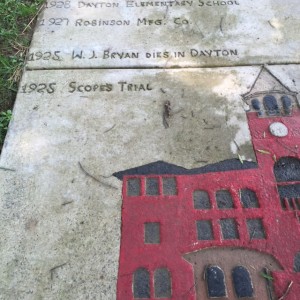
Here is a picture of a part of the sidewalk outside of the Dayton County Courthouse, recounting the history of the county.

ScopesTrial

DAWG BONE: IF YOU HAVE A CHANCE TO GO TO DAYTON, TENNESSEE, GO BY THE MUSEUM!

CAN THE SCHOOL CONTRACT WITH A CHRISTIAN SCHOOL FOR ALTERNATIVE EDUCATION SERVICES?

The 6th Circuit Court of Appeals recently concluded that it was permissible for a public school district to send its students to a Christian school for “alternative school services.”  The court held that the arrangement, which was in effect for about seven years, did not violate the Establishment Clause.  There was no direct religious instruction, and the students “encountered only de minimis religious references” at the school, such as Bible quotes on report card forms.

The case is a strange one.  The Jefferson County Board of School Commissioners (Tennessee) was in a pinch due to severe budget cutbacks. They had a duty to provide alternative services (like our DAEPs) but needed to figure out a way to do it at less expense. So they shut down their own alternative schools, and contracted with a Christian school to provide the services.  The opinion does not explain why the arrangement with the private school was so much cheaper, but apparently, it was.   The Director of the Board figured they would save $170,000/year.

Suits that challenge religious practices are often brought by the ACLU or some “secular humanist” organization but that was not the case here. This case was brought by two teachers who lost their jobs as a result of the decision to close the alternative school operated by the county.  One of the judges thus characterized the case as “an employment contract dispute masquerading as an Establishment Clause case.”

We don’t anticipate a fact situation like this coming up in Texas, where DAEPs are well established, and mandated by law. But the case is interesting because it adds to the confusing mess of the law pertaining to religion and the public schools.

Courts have told us that it is not OK to hold the high school graduation in a church, Doe ex. rel. Doe v. Elmbrook School District, 687 F.3d 840 (7th Cir. 2012) (en banc); and it is not OK to display a framed painting of Jesus in the school hallway, Washegesic v. Bloomingdale Public Schools, 33 F.3d 679 (6th Cir. 1994). But it is OK to send a bunch of kids to a Christian school over a period of several years.

There are few areas of the law more confusing than the role of religion in the public schools.  Tread carefully, and with the advice of your school district’s lawyer! This case is Smith v. Jefferson County Board of School Commissioners, decided by the 6th Circuit Court of Appeals on June 11, 2015.

And speaking of Tennessee, religion, and public schools—be sure to check the Daily Dawg tomorrow!

DAWG BONE: JUDGES CONTINUE TO STRUGGLE TOWARD CONSISTENCY IN RELIGION CASES.

IS THAT SPEECH THERAPIST AN “EMPLOYEE” OR AN “INDEPENDENT CONTRACTOR”?

President Lincoln reportedly liked to pose this question: how many legs does a horse have, if we call his tail a leg?

The answer is four.  The point is that calling the tail a leg does not make it a leg.  It’s still a tail.

That is also the approach of the Department of Labor when it comes to “employees” vs. “independent contractors.”  Calling the person an “independent contractor” does not make them one.  DOL will look right past that agreement that you signed, and look instead at the actual relationship.  If it looks like an employment relationship to DOL, they will treat it as such, with all of the tax consequences this entails.

DOL has recently issued an “Administrator’s Interpretation” that highlights this issue.  Take a look at the document:  http://www.dol.gov/whd/workers/misclassification/AI-2015_1.htm

This is a high priority issue with the DOL, and school districts can be prime targets for investigations.

DAWG BONE:  CALLING SOMEONE AN INDEPENDENT CONTRACTOR DOES NOT MAKE THEM ONE.  


FIRST DAY OF INSERVICE!

If all goes according to plan, as you read this I should be on my way to Southfork Ranch to address the assembled administrators of Garland ISD. For me, this marks the opening bell of the new school year—the first inservice.  I expect you have heard the observation that teacher inservice is the best time for a person to die—because the transition from life to death is so subtle.

I hope to make my inservice presentations more lively than that.  Fortunately, I always have interesting things to talk about, since the law is ever evolving.

But here are a few observations about teacher inservice from a veteran:

1. The coaches always sit in the back. And they were off task long before the rest of you were. Nowadays, everyone is off task, or at least prepared to be so. Just about everyone has a cell phone or ipad at the ready in case the presentation is a total bore.  But the coaches were ahead of the rest of you on this, diagramming plays in the back of the room.

2. We speakers always appreciate the folks who sit up front.

3. It’s really hard to corral a group of teachers coming together after being apart for the summer. They have too much to talk about.

4. If you are the speaker, try not to come up after the magician.

5. Also: try not to come up after the superintendent has explained the higher cost of insurance and the likelihood of no pay increase for the next five years.

6. The women in the audience appear to be more attentive than the men, but they are not. They are more likely to make eye contact with the speaker, and to nod and smile. But that’s just that nurturing, helpful maternal thing. They are trying to help the speaker along with nods and smiles, which is all very nice, but this doesn’t mean they are really listening.

7. The men in the audience don’t give a flip about helping the speaker along, so you won’t get those nods and smiles. But you can tell when a man is really listening carefully because his head goes diagonal.  I think this is because the male brain is not as well connected as the female brain. Women have a brain that is well connected—the right half and the left half, that is. So they can listen to the speaker with both halves of the brain, while holding the head upright. The male brain is not as well connected, so we men have to cheat a bit, and go diagonal with the head.  As you can tell, I know a lot about the human brain.

I enjoy speaking to educators.  On the whole, y’all are a good audience, and I look forward to another year on the road.  In fact, in September and October alone I will be speaking in Regions 1, 2, 3, 7, 8, 9, 10, 11, 12, 13, 15, 17, 18, 20, the Harris County DOE, the TASB Convention and a TCASE/Legal Digest Conference. See you on the road!

DAWG BONE: INSERVICE STARTS THE YEAR!

REPORTING POSSIBLE MISCONDUCT TO SBEC

GREETINGS from the Dawg’s new home!! I am pleased to let you know that the law firm of Walsh Gallegos Trevino Russo and Kyle, P.C., has acquired the EdLawDaily, or as I like to call it, The Daily Dawg. Henceforth you will be getting your Dawg Bones and other assorted legal nuggets via the law firm. Many thanks to Park Place Publications for giving the Daily Dawg a terrific launch. In particular, my thanks go to Ted Siff, Ambrose Austin and Stephen Markel—the Park Place staff that have made this work so well.

Now, as for today’s content:

We had some concerns that the teacher was “getting involved” with a student.  He quit. Do we have to report to SBEC?

The Legislature continues to tighten up reporting requirements in an effort to keep kids safe at school.  HB 1783, which takes effect on September 1 of this year, is the latest effort along these lines.  This new law makes a subtle but important change in the duty of superintendents and others to report possible misconduct to the State Board for Educator Certification.  Current law requires a report if a certified educator was terminated “based on a determination” that the educator engaged in certain types of misconduct.  Reports are also required under current law if the educator resigned “and reasonable evidence supports a recommendation by the superintendent or director to terminate” employment of the educator.

The new law does the following:

  1. It adds a new category of reportable conduct: if the educator was terminated based on evidence that the educator was involved in a romantic relationship with a student, or solicited or engaged in sexual contact with a student or a minor.
  2. It requires a report if the termination is based on “evidence” of the misconduct, rather than a “determination” that the conduct occurred.
  3. It requires a report if the educator resigned and there is “evidence” that he/she engaged in the prohibited misconduct. Current law speaks of “reasonable evidence” that “supports a recommendation” to terminate.
  4. It requires a report if the district obtains information about an educator’s criminal record via means other than the official criminal history clearinghouse.
  5. It requires superintendents and others to complete the investigation of possible misconduct involving romantic relationships with students, even if the employee resigns before the investigation is complete. Current law requires this only in cases of actual abuse or unlawful acts with students or minors.
  6. It applies these reporting standards to superintendents or directors of open enrollment charter schools.

So if you have an employee who resigns in the face of allegations of romantic involvement with a student, you should contact your school’s lawyer. The issue—as of September 1—will be if there is “evidence” of the misconduct—not whether there is sufficient “reasonable evidence” to support a recommendation to terminate.

DAWG BONE: TEACHERS WHO GET ROMANTICALLY INVOLVED WITH STUDENTS PUT THEIR TEACHING CERTIFICATES AT RISK.

File this one under: LEGISLATION 2015

IS IT A GOOD IDEA TO PUT A BODY CAMERA ON THE PRINCIPAL? “PRINCIPALCAM”?

NOTE TO OUR READERS: As of Monday, the EdLawDaily will have a new home. You will continue to receive this content, but it will be sent to you from the law firm of Walsh Gallegos Trevino Russo and Kyle, P.C. We anticipate a smooth transition from Park Place Publications to the law firm, but if you experience any problems, please contact MICHELLE PHELPS at info@wabsa.com.

Dear Dawg,

We are instituting a pilot program on one campus this year, whereby the principal and assistants will be required to wear body cameras at all times. We have had too many complaints of inappropriate conduct.  99% of the time our staff has done nothing wrong. So we think this new tech tool will help protect our staff from accusations of wrongdoing. Plus, when someone has done something wrong, we will have the evidence we need.   A local technology store is underwriting the costs on this. So it looked like a good deal. 

But the problem is human error. You see, they are supposed to turn the dadgum thing off at certain times. Like when they go to the bathroom.

We had our administrators wearing the cameras, just to get used to them, on our first days back as we prepare for the new year.  Sure enough, Principal Notsosmart forgot to turn it off when he went to the john.  And someone (we suspect the assistant principal) somehow got hold of the recording and posted it on YouTube.

It’s not very visually interesting.  An incredibly close-up look at tile grout.  And we hear the splashing of liquids, along with the voices of the principal and someone else, telling bad bathroom jokes.  There is at least one loud bodily noise as well.  It’s not racist or sexist or politically incorrect in the least. It’s just stupid and embarrassing.  --WADDYATHINK?

DEAR WADDYATHINK:

We think you should wait on Iowa.  The Burlington Community School District in Iowa is reportedly outfitting its principals and assistants with body cameras for the upcoming school year. So it might be a good idea to let them be the test case with this new technology.

Here in Texas we have a legal issue to consider, as well as the likelihood of more embarrassing moments.  Remember that we have a law that limits the authority of school officials to video or audio record students.  Section 26.009 of the Education Code requires school officials to obtain written parent consent before making, or authorizing the making of, a video or audio recording of a student. There are some exceptions to that general rule. Among other exceptions, you can have cameras for purposes of safety in “common areas of the school or on school buses.” But if the principal is wearing the camera at all times, you are likely to move beyond those common areas.  Besides, you already have the authority to put up a camera in the hallways, cafeteria and other “common areas.”

That new law that requires cameras in some of our special education classrooms is not in effect for this school year. It goes into effect with the start of the 2016-17 school year.  So the current law restricts the use of video and audio recording, and we suspect that a body camera would seriously increase the risk of a violation of the current law.

So why not let the Hawkeye State take the lead on this.  Best of luck to you and Principal Notsosmart.

DAWG BONE: PRINCIPALCAM: AN IDEA WHOSE TIME HAS NOT YET COME.


LEGISLATIVE ALERT! SUBTLE CHANGE IN THE LAW RE: WEAPONS POSSESSION

SB 107, recently enacted by our Legislature, requires each campus to identify a Campus Behavior Coordinator.  That’s the part of this new law that has drawn the most interest. But SB 107 also makes a subtle but important change in the law pertaining to the possession of weapons at school.

Prior law called for the expulsion of a student who “uses, exhibits, or possesses” certain weapons: a firearm, illegal knife, a club, or any weapon prohibited by Penal Code 46.05.

The new law calls for expulsion of the student who “engages in conduct that contains the elements of the offense of unlawfully carrying weapons under Section 46.02, Penal Code, or elements of an offense related to prohibited weapons under Section 46.05, Penal Code.”

The “elements of the offense of unlawfully carrying weapons” under 46.02 are:  1) that the person carried the weapon “on or about his or her person”; 2) that the carrying was done “intentionally, knowingly or recklessly”; and 3) that the weapon was a handgun, illegal knife, or club.  So what does that have to do with the illegal knife in the locker?  The argument will be made that “in the locker” is not “on or about his or her person.”  Is having a knife in the locker subject to discipline? It would be if your Code of Conduct says so. But with this new law in place, it may not meet the definition of a mandatory expellable offense under Chapter 37.

What about 46.05?  That statute makes it an offense to “intentionally or knowingly” possess, manufacture, transport, repair or sell an explosive weapon, a machine gun, a short-barrel firearm, a firearm silencer, knuckles, armor-piercing ammunition, a chemical dispensing device, a zip gun, or a tire deflation device.  Notice: knives are not on that list.

This law, like most of Chapter 37, does not apply to charters. But for the traditional schools, this will require careful attention to your Code of Conduct.

DAWG BONE: A GOOD ASSISTANT PRINCIPAL HAS THE CODE OF CONDUCT CLOSE TO MEMORIZED


COST CONTROLS FOR INDEPENDENT EDUCATIONAL EVALUATIONS

The parent wants us to pay for an IEE that we think is too expensive. What do we do?

A Texas hearing officer recently ruled in favor of a school district that put a cap on how much it would pay for an IEE—an Independent Educational Evaluation.  Districts are allowed to have criteria pertaining to IEEs, including cost controls. This case involved a parent’s request for an independent evaluation for autism that would run $7,200, and that would not include the cost of a Functional Behavioral Assessment. The FBA would be done at $125/hour and could add up to an additional $9,700.  This exceeded the district’s cap.  The parent also requested a speech evaluation that was going to cost $1,500—four times the district’s cap.

The law is clear that districts can have “caps” on what it will pay, but there are two important caveats to add. First, “unique circumstances” must always be recognized and accommodated.  Second, the district has to base its cap on realistic and accurate information. You can’t just pick a number out of the air. Here, the hearing officer concluded that the “district’s evidence on appropriate costs of IEEs was based on substantial objective data relevant to the issues presented by the parties.”  The paragraph citing how the district did this is worth quoting in full:

The district has adopted operating guidelines for independent educational evaluations and their costs.  The guidelines are based upon research in typical costs for evaluations within the geographic area, consideration of the evaluator’s credentials and the unique needs of the student, and approximations of costs up to 35% higher than Medicaid rates for the service. Data to establish the guidelines is gathered from two regional education service center regions and includes objective data from school districts, various professionals and private providers.

The case is Student v. Lewisville ISD, decided by hearing officer Lucius Bunton on June 5, 2015.  The docket number of the case is 107-SE-1214, and you can find it on the T.E.A. website:  http://tea.texas.gov/About_TEA/Legal_Services/Special_Education/Due_Process_Hearings/Special_Education_Due_Process_Hearings_2015/.

DAWG BONE: COST CRITERIA REGARDING IEEs REQUIRES RESEARCH, DATA.